Arizona’s fledgling statehood was barely a year old, and Native Americans wouldn’t have the right to vote for another 11 years when Kenneth Begay (1913-1977) was born in a hogan in rural Steamboat Canyon in eastern Arizona. The wide-vista Colorado Plateau lined with rows of red-yellow sandstone buttes was where the fledging silversmith learned his craft at the Fort Wingate Indian School. His mentor was the famous silversmith Fred Peshlakai who had begun teaching at the school in 1931. Peshlakai and his younger brother Frank were the sons of one the earliest and most recognized silversmiths, Slender Maker of Silver, who started producing jewelry in the 1870s.
Peshlakai was born at Crystal, New Mexico, not far from where Begay attended Indian school. Peshlakai was one of the first silversmiths to start signing his work using a small hogan design hallmark, which he used before 1934 to 35. He ultimately sold his hallmark to Begay, and the mark would become the emblem for the White Hogan. The hogan stamp was patented in 1983 and was first in use around 1948.
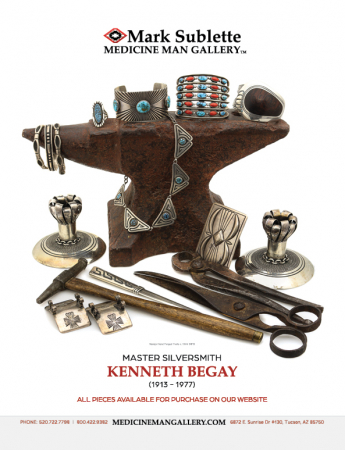
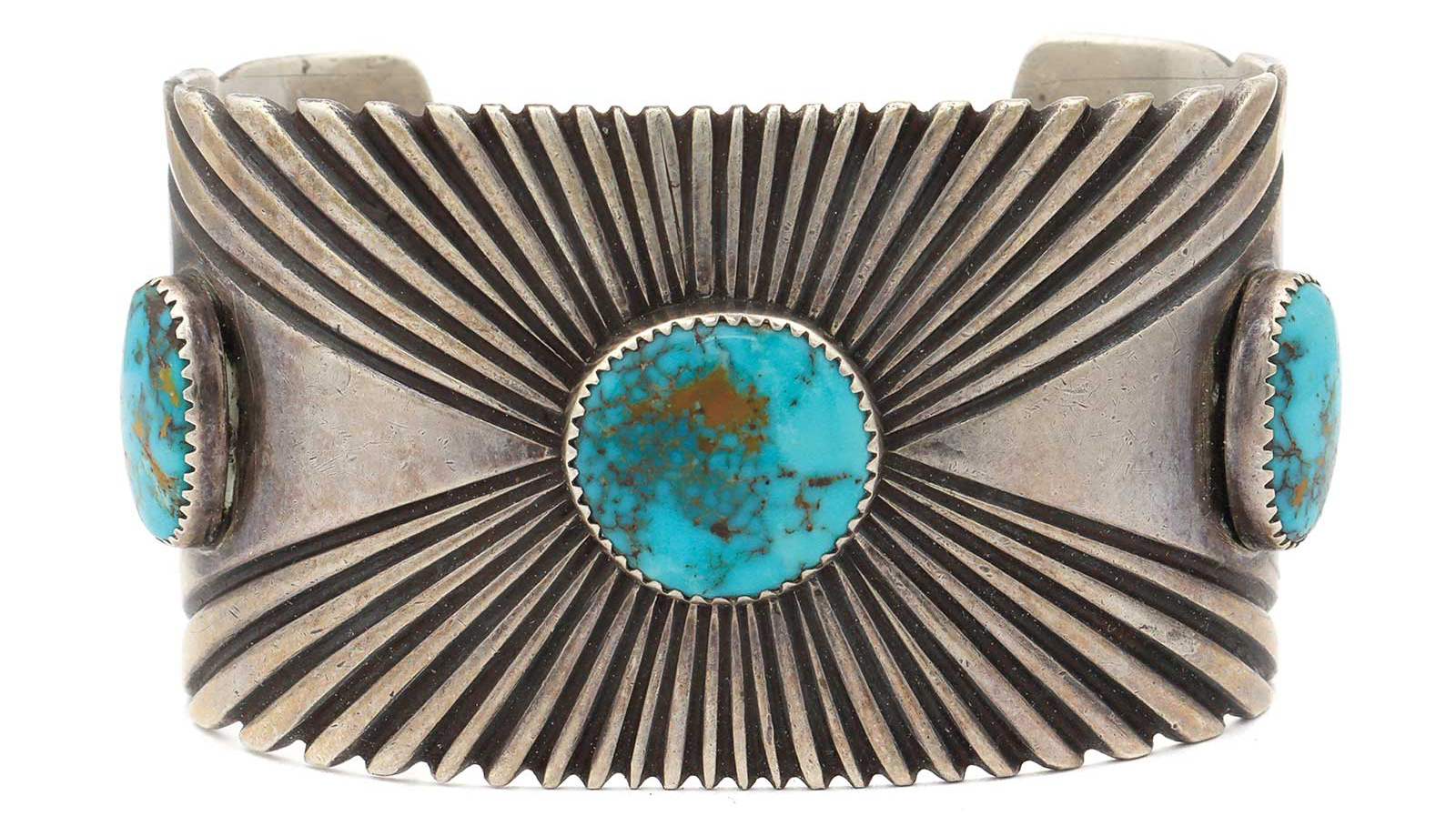 Kenneth Begay (Navajo, 1913-1977), bracelet with turquoise, 1950-60.
Peshlakai was an interesting person in his own right. In the 1920s, he worked as an actor, cowboy, and even exhibited at the 1934 Chicago World’s Fair. He worked for numerous Indian shops in Phoenix, including Skiles and Vaughn’s, before running his shop in Los Angeles in the 1940s and Cedar City, Utah, in 1950.
Peshlakai was known for his elaborate yet clean jewelry style with modern designs and the highest quality stones. Preferring Lone Mountain Turquoise, he signed his work “FP”, often using an arrow through the initials. His early 1940s work was simply stamped “FP.” Begay followed Peshlakai’s unique eye and masterful craftsmanship to help shape his artistic muscle, which would be considered the cutting-edge jewelry of the 1950s and ’60s.
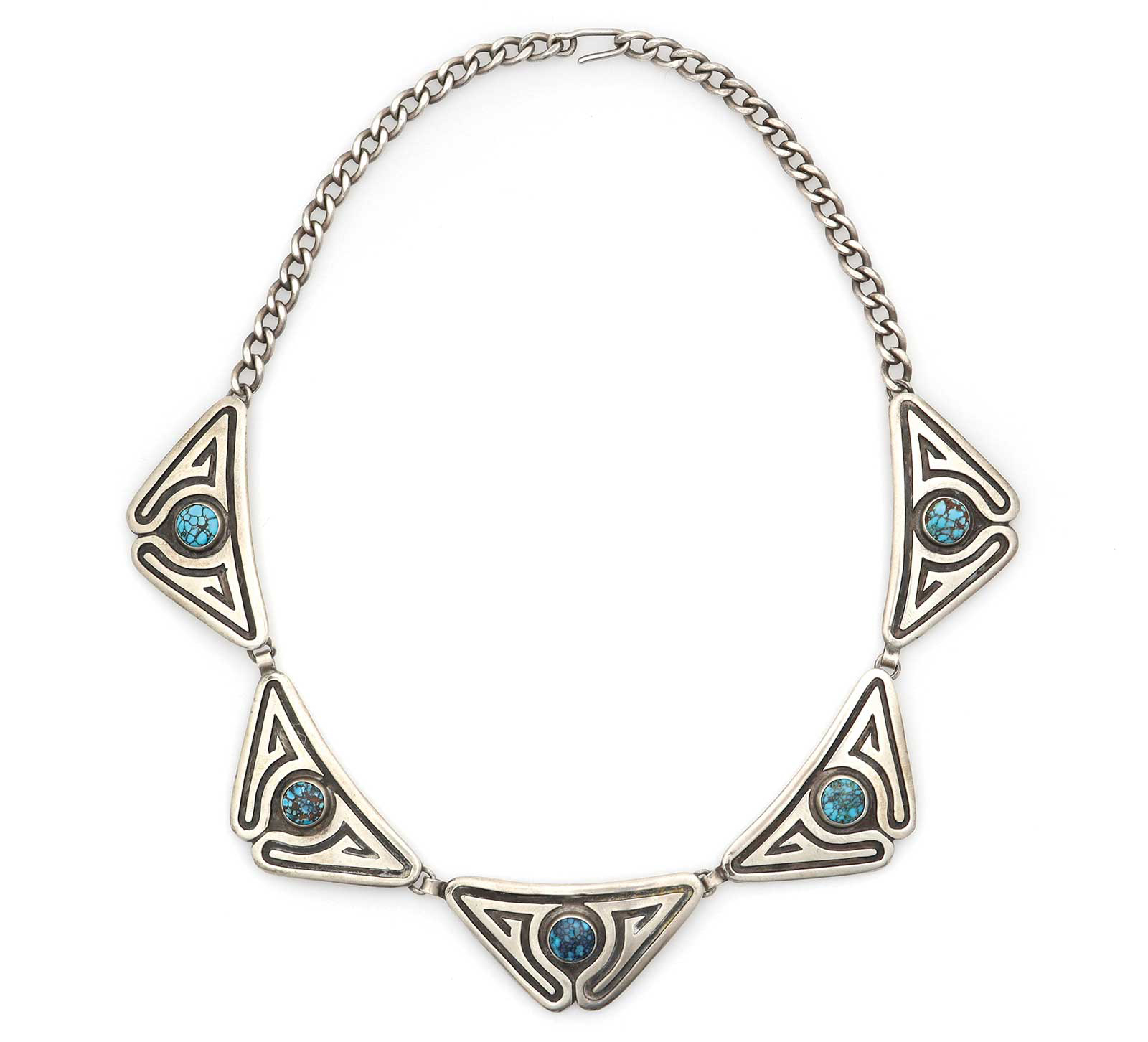
Kenneth Begay (Navajo, 1913-1977), necklace with Lone Mountain turquoise, 1960.
Like any good silversmith, Begay paid his dues. He started as a blacksmith, and from that humble beginning, learned to make his tools, stamps and dyes, a critically important skill set if you want to excel at silversmithing. He went to school to increase his breadth of knowledge; learning from one of the best silversmiths, he transitioned to demonstrate silversmithing at national parks, including the Grand Canyon, Zion National Monument and Bryce Canyon. Begay settled in Flagstaff in 1937, married, and began working for the Babbitt Brothers, a well-known early Arizona merchant family.
At this phase in his life, Begay was making traditional jewelry. Over the next nine years, he would gain enough experience to open his store with Allen Kee, his cousin and an excellent silversmith, and John and Virginia Bonnell.
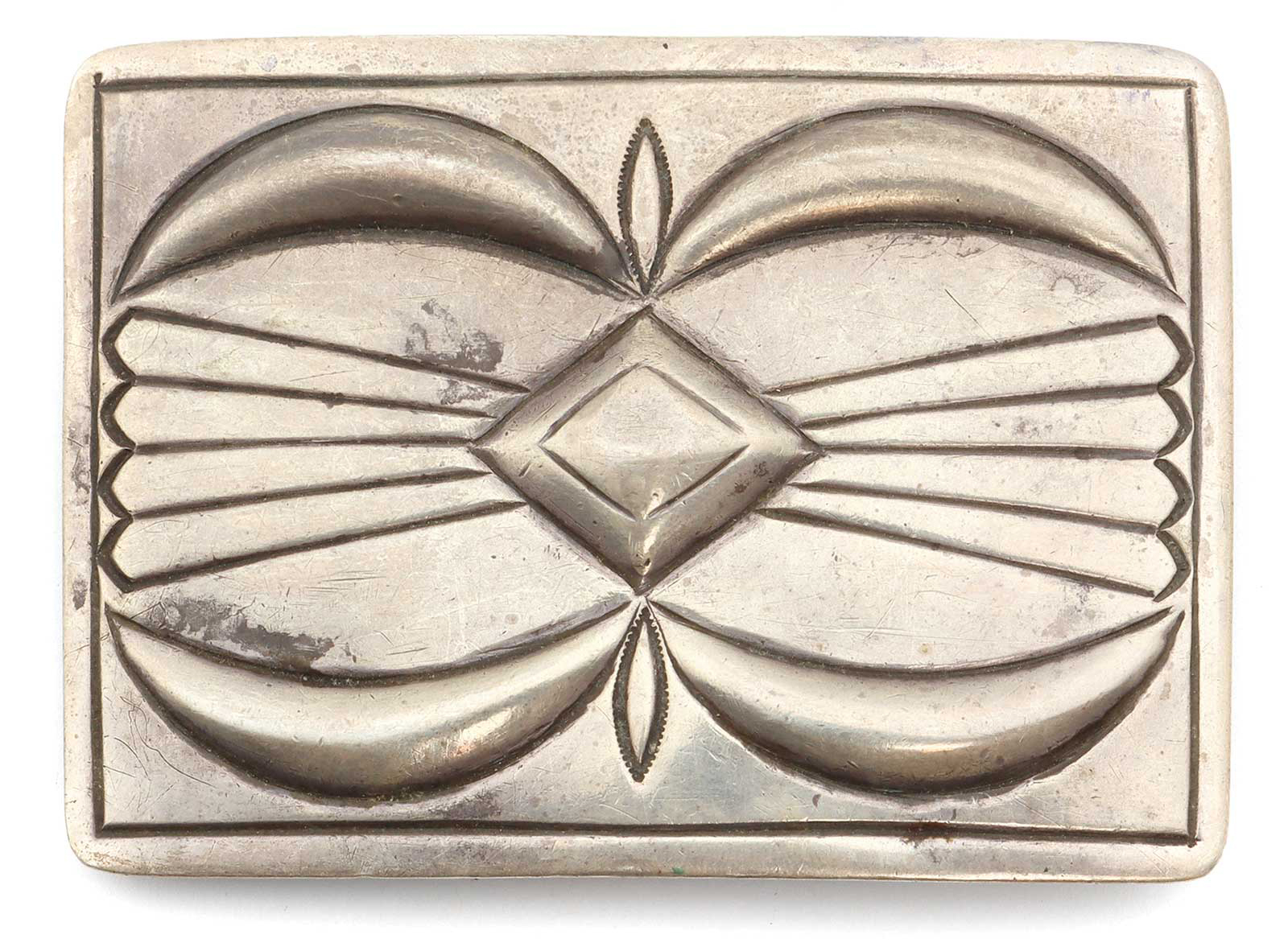 Kenneth Begay (Navajo, 1913-1977), belt buckle, 1950.
Bonnell moved to Arizona in 1936 and managed Fred Wilson’s Indian Trading Post in Phoenix. Along with his bench Navajo silversmiths, he began the iconic White Hogan store, using the hallmark that Begay had purchased from Peshlakai. The White Hogan’s slogan was “Home of the World’s Most Distinctive Indian Silver,” a moniker well deserved. The White Hogan silversmiths dominated the Gallup Inter-Tribal Ceremonial starting in 1950, and in 1956 set a single division record of 98 ribbons. Begay won 1st place in 1950 at the Inter-Tribal Ceremonial in Gallup and the Arizona State Fair, letting the Indian jewelry collecting community know, in no uncertain terms, that he had arrived.
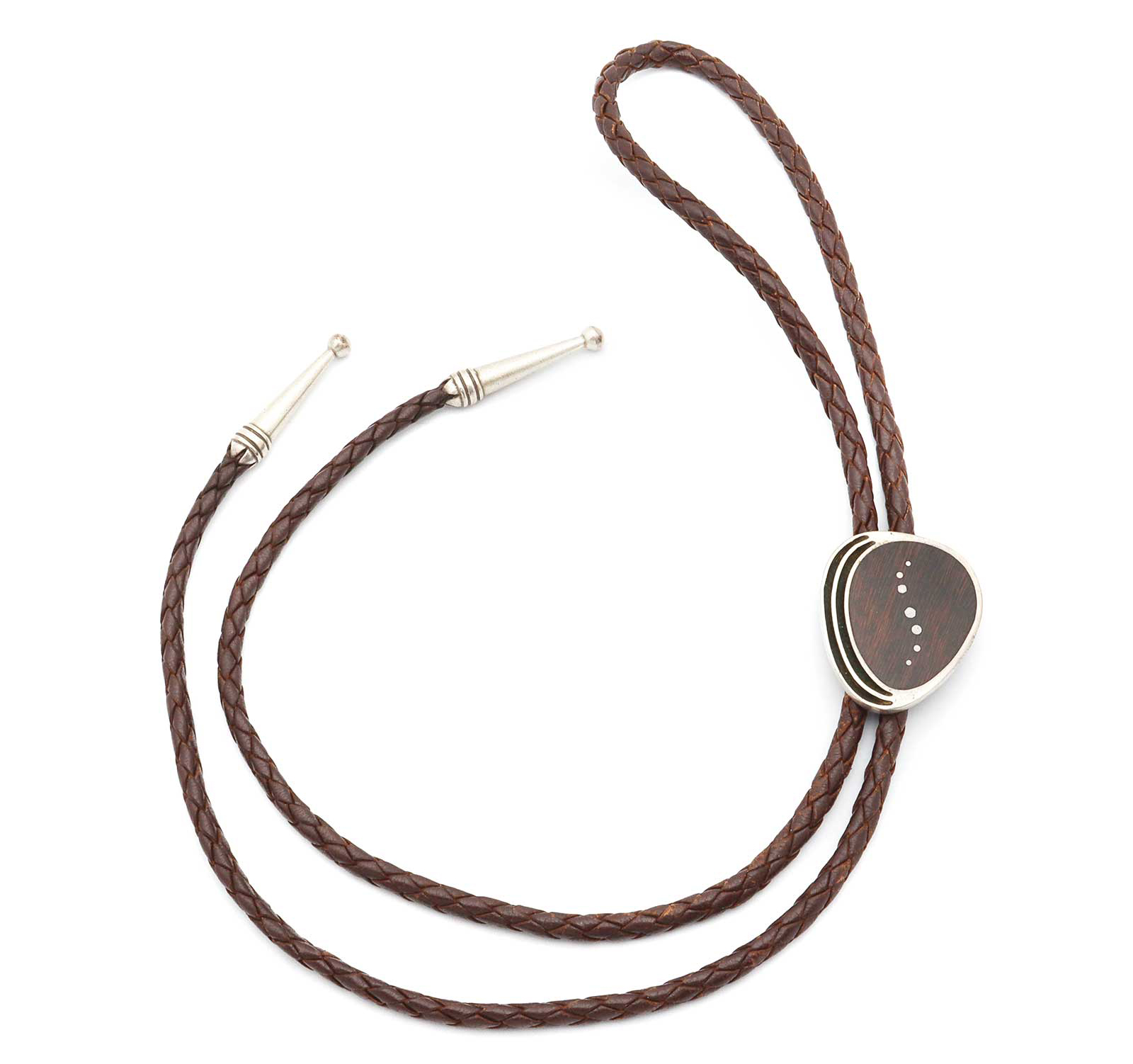 Kenneth Begay (Navajo, 1913-1977), ironwood bolo, 1950.
The White Hogan was unique not only for their distinctive modern designs but also the way they approached business, paying higher wages to the bench silversmiths, which included profit sharing. Begay was at the forefront of innovation, drawing hundreds of jewelry mockups as a reference during his tenure at the White Hogan. He would construct elegant minimalistic unique jewelry designs, tableware, decorative plates and even one-of-a-kind letter openers. A unique piece would be stamped with its signature KB White Hogan symbol and the words “Hand Made.”
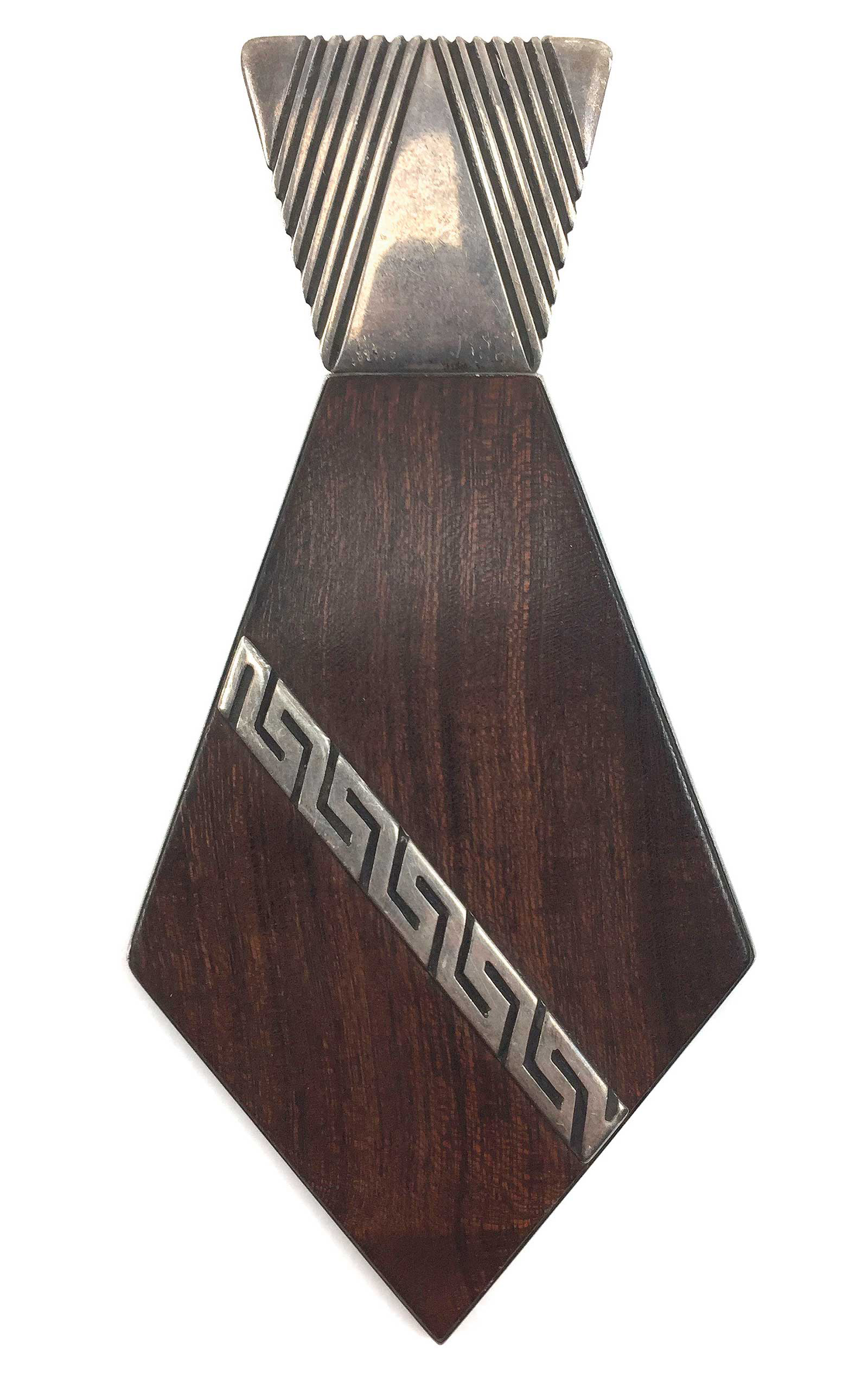 Kenneth Begay (Navajo, 1913-1977), necktie, 1950-60.
During this time frame, Begay signed his work “KB,” or “KB” in a serrated box, which would also have the White Hogan hallmark. One of his well-known jewelry forms was to incorporate Arizona ironwood starting around 1952 into various pieces ranging from clip-on ties, bolos, earrings and bracelets, to dinnerware.
Not only did Begay produce jewelry at the White Hogan, but his brother Johnny Mike Begay, known for his railroad bracelet design, and son Harvey Begay also created masterful pieces. Harvey worked from age 14 to 18 as a bench silversmith at the White Hogan. Harvey Begay used traditional motifs, combining them with modern designs in gold and silver using the best turquoise, and became a celebrated jewelry artist in his own right. Allen Kee, a master silversmith and Begay’s partner, brought on his two brothers Ivan and George, whose work was elegant and highly sought after by collectors.
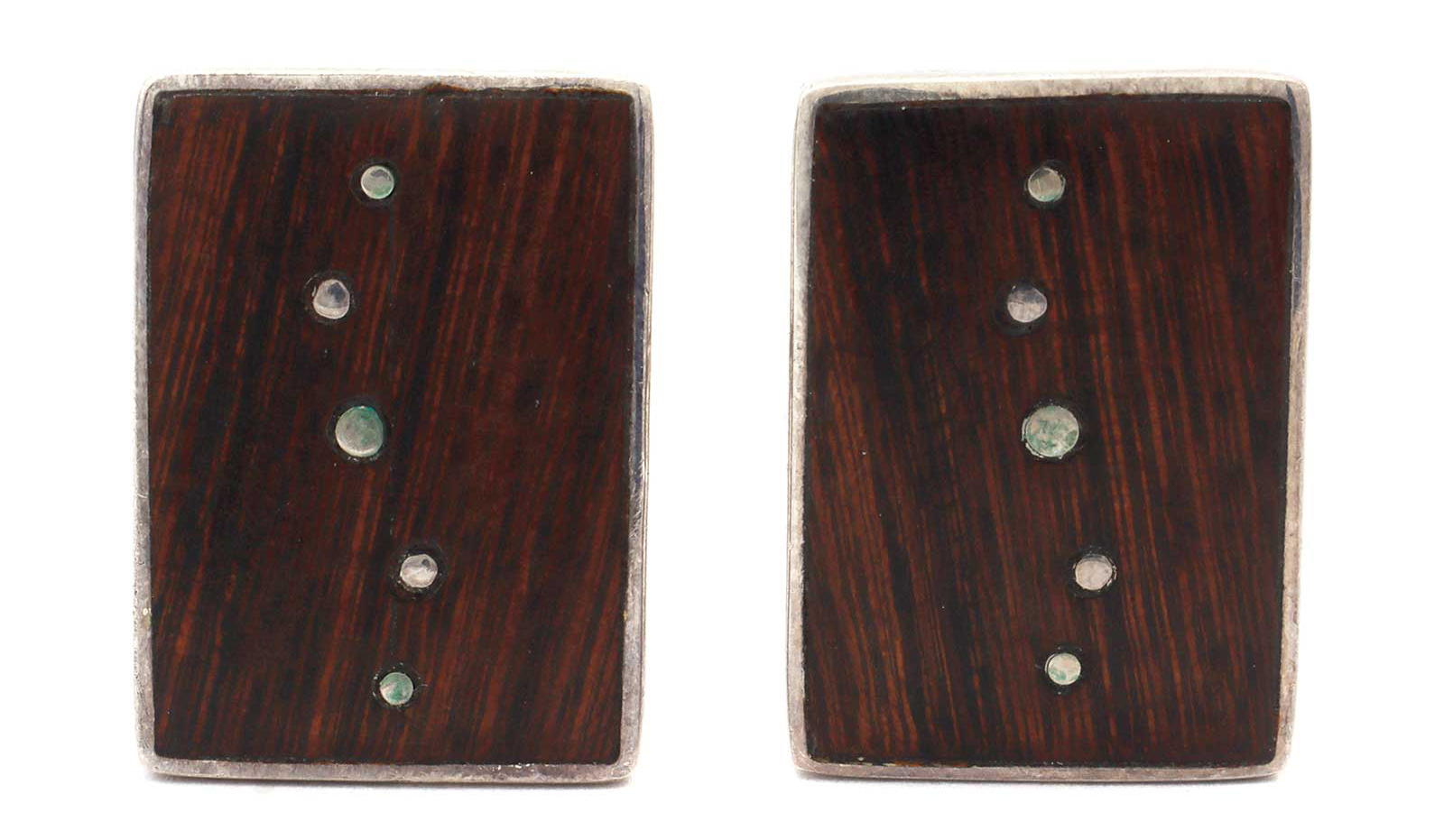 Kenneth Begay (Navajo, 1913-1977), cufflinks, 1950.
Begay moved on from the White Hogan in Phoenix in 1964 to manage the Cameron branch of the Navajo Arts and Crafts Guild in Northern Arizona. In 1969, he left the Guild to become the first jewelry instructor for Navajo Community College in Many Farms, Arizona. Begay retired in 1972 from the college and moved back to his boyhood home in Steamboat Canyon, working until his death in 1977. Art Historian Dexter Cirillo coined Begay, “The Father of Navajo Jewelry,” and felt Begay revolutionized Native jewelry by reducing “the design to a single element.”
 Kenneth Begay (Navajo, 1913-1977), letter opener, 1960.
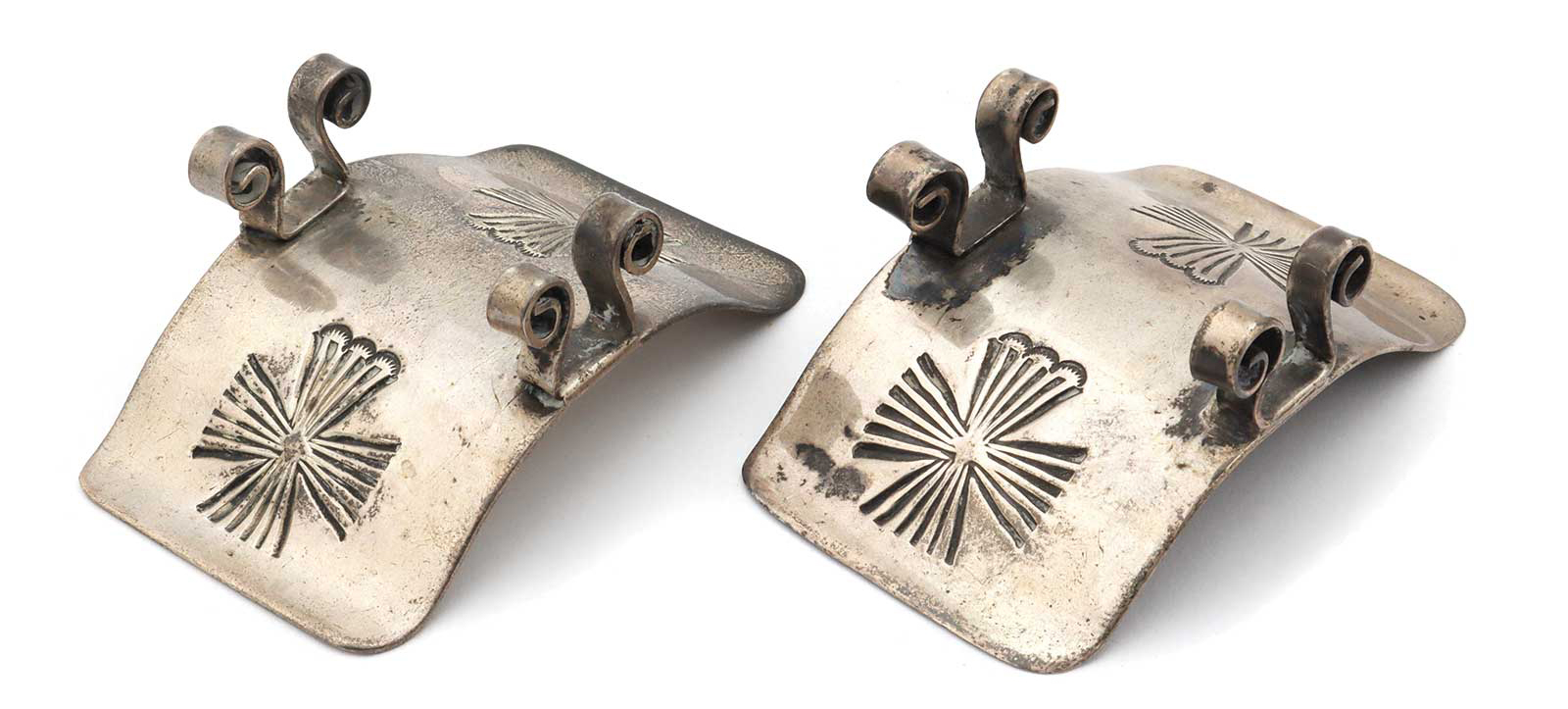 Kenneth Begay (Navajo, 1913-1977), card holders, 1950-60.
In 2000, Begay received a posthumous Lifetime Achievement Award from SWAIA, an honor well deserved. His jewelry is in the permanent collection of the Smithsonian, Los Angeles County Museum of Art, DeYoung Museum and the American Museum of Natural History, to name just a few.
Begay’s unique perspective, sleek designs, and skill set place him as one of the most important silversmiths during the 1950 to 1970s. Begay’s jewelry for multiple cast pieces such as earrings and smaller pieces can start around $250, a great bracelet can easily bring $9,500, and one of his uniquely designed platters up to $30,000.
About the Author
Dr. Mark Sublette, a former physician, is the founder of Medicine Man Gallery. He is the author of numerous catalogs on Navajo textiles, and published authority of the lifeworks of Maynard Dixon. Sublette’s involvement in the arts is all encompassing. He buys, sells and researches. A constant student of the many areas he delves into, he is happy to pass along his knowledge through his YouTube channel MedicineManGallery. The delight in sharing his passion and his deep love of art and admiration of artists is evident as he speaks.
Powered by Froala Editor